
Note from Earl (February 2026): I rage-typed the original version of this post in a breakroom in 2019 while counting down the minutes until I could escape. Fast-forward to today: I hit my ~$2M net worth goal, fired my boss, and never looked back. No more pointless Zooms, no more Slack doom-scrolling. If your job is stealing your soul, here is the no-fluff playbook I used to buy my freedom—updated with the freshest 2026 data.
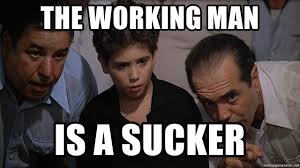
In the movie A Bronx Tale, Sonny says: “The working man is a sucker.”
He’s right—if you’re grinding away decades for nothing but bills, burnout, and zero escape velocity. The real “sucker move” isn’t having a job; it’s staying trapped because you haven’t built a way out. Financial independence (FI) isn’t some beach-bum fantasy; it’s leverage. It’s having enough assets so a toxic boss, a layoff, or a bad year doesn’t own you.
The 2026 Workplace Reality Check
Gallup’s State of the Global Workplace: 2025 report nails the problem: Only 31% of U.S. employees are actually engaged at work. The rest are just surviving until Friday.
In 2026, the traps are tighter than ever:
- AI & the “Always-On” Squeeze: Productivity is soaring, but boundaries are vanishing. “Flexible work” often just means 24/7 availability.
- The Paycheck Illusion: Your salary is a trade, not a gift. If you aren’t funneling at least 40% into investments, you’re just funding someone else’s retirement.
- Quiet Quitting is a Slow Death: Reducing your effort feels like payback, but it drags out the misery without building an off-ramp.
The $2M Exit: What the Math Says in 2026
You don’t need a winning lottery ticket—you need a portfolio that covers your life reliably.
Morningstar’s State of Retirement Income (Dec 2025) sets the base safe starting withdrawal rate at 3.9% for a 30-year retirement (assuming 90% success probability and a balanced portfolio).
For a $2,000,000 Portfolio:
- The Income: ~$78,000/year initial withdrawal, inflation-adjusted.
- The Context: Federal Reserve data (SCF benchmark) shows the median retirement savings for ages 65–74 is only ~$200,000. Hitting $2M puts you in the top percentile—achievable with discipline and compounding, not luck.
How I Turned 25 Years of Grind Into Freedom
My corporate life was a cycle of politics and undervalued work. I didn’t “find my passion”—I weaponized my frustration.
- Automated High-Octane Saving: Maxed the 401(k), then auto-transferred the rest to low-cost index funds (VTI/VTSAX) and dividend-growth stocks.
- Ruthless Lifestyle Control: No “retail therapy” for work stress. Every $1,000 I didn’t spend on junk was a month of future freedom.
- Tracked Like a Hawk: I monitored my net worth monthly. Once I hit ~$1.5M, the fear died. I stopped people-pleasing and started time-guarding.
Your Actionable 2026 Roadmap
Work sucks? Solving it is a math and strategy problem.
- Find Your Number: Annual expenses × 25–26 (for a ~3.9–4% base). E.g., $60k expenses → ~$1.5M target.
- Crank the Savings Rate: Aim for 40–60%. Automate it: pay yourself first.
- Invest Boring & Cheap: Broad index funds/ETFs. Ignore the hype.
- Monitor Your Progress: Review quarterly. Track your “Freedom Date” using the 5 Tool Calculator Suite.
Job “security” is a myth. Real security is assets working for you. Start today: Pull your numbers and set one auto-transfer. Momentum snowballs.
Frequently Asked Questions (FAQ)
Morningstar’s latest research sets the base at 3.9% for consistent inflation-adjusted spending over 30 years (90% success probability).
Yes for many—it supports $78k/year initially. It depends on your lifestyle, location, and healthcare costs. Compared to the U.S. median of $200k, you are in a very strong position.
Take your annual expenses and multiply by 25 to 30. Example: $50k/year expenses → $1.25M to $1.5M target.
No. It keeps you stuck in the grind longer. Better to channel that frustration into maximizing your income and savings rate to exit the system entirely.
Ready to fast-track your freedom? I built my $2M net worth using these two core systems. Stop guessing and start building:
- The Financial Freedom Compass: A free, 48-lesson course to bridge your financial literacy gap.
- My FIRE Toolkit: The exact calculators and tracking sheets I used to hit my 2028 goals.
- Check out my full story here to see the year-by-year math behind the results.
Sources & Citations
- Morningstar. (December 3, 2025). What’s a Safe Retirement Withdrawal Rate for 2026? https://www.morningstar.com/retirement/whats-safe-retirement-withdrawal-rate-2026
- Morningstar. (2025). The State of Retirement Income for 2026. https://www.morningstar.com/business/insights/research/the-state-of-retirement-income
- Gallup. (2025). State of the Global Workplace: 2025 Report. U.S. engagement at 31%. https://www.gallup.com/workplace/349484/state-of-the-global-workplace.aspx
- Federal Reserve Board. (2022 Survey of Consumer Finances, benchmark in 2025/2026). Median retirement accounts by age. https://www.federalreserve.gov/econres/scfindex.htm

He didn't just save his way to freedom; he built a compounding engine. By combining "Bogleheads" index investing with a conservative options strategy, Earl turned a late start into a total victory. He’s not just talking theory—he’s living the math. Last year alone, Earl generated $78k in options premiums via the "Wheel" strategy and ~$400/month in passive dividends, proving that liquidity is the true key to quitting early.
Launched in 2019, EarlyRetirementEarl.com is a no-BS zone for dads and late-starters who want actionable, battle-tested steps to freedom. Featured on ThinkSaveRetire, ESI Money, Budgets are Sexy, and Camp Fire Finance, Earl’s mission is to share the financial literacy he was never taught in school. No fluff, no gurus—just the math.
Not financial advice. I’m not a CFP or licensed advisor. All numbers are historical; markets fluctuate. Past performance is not indicative of future results. Do your own research and consult a professional.